 Toot Digital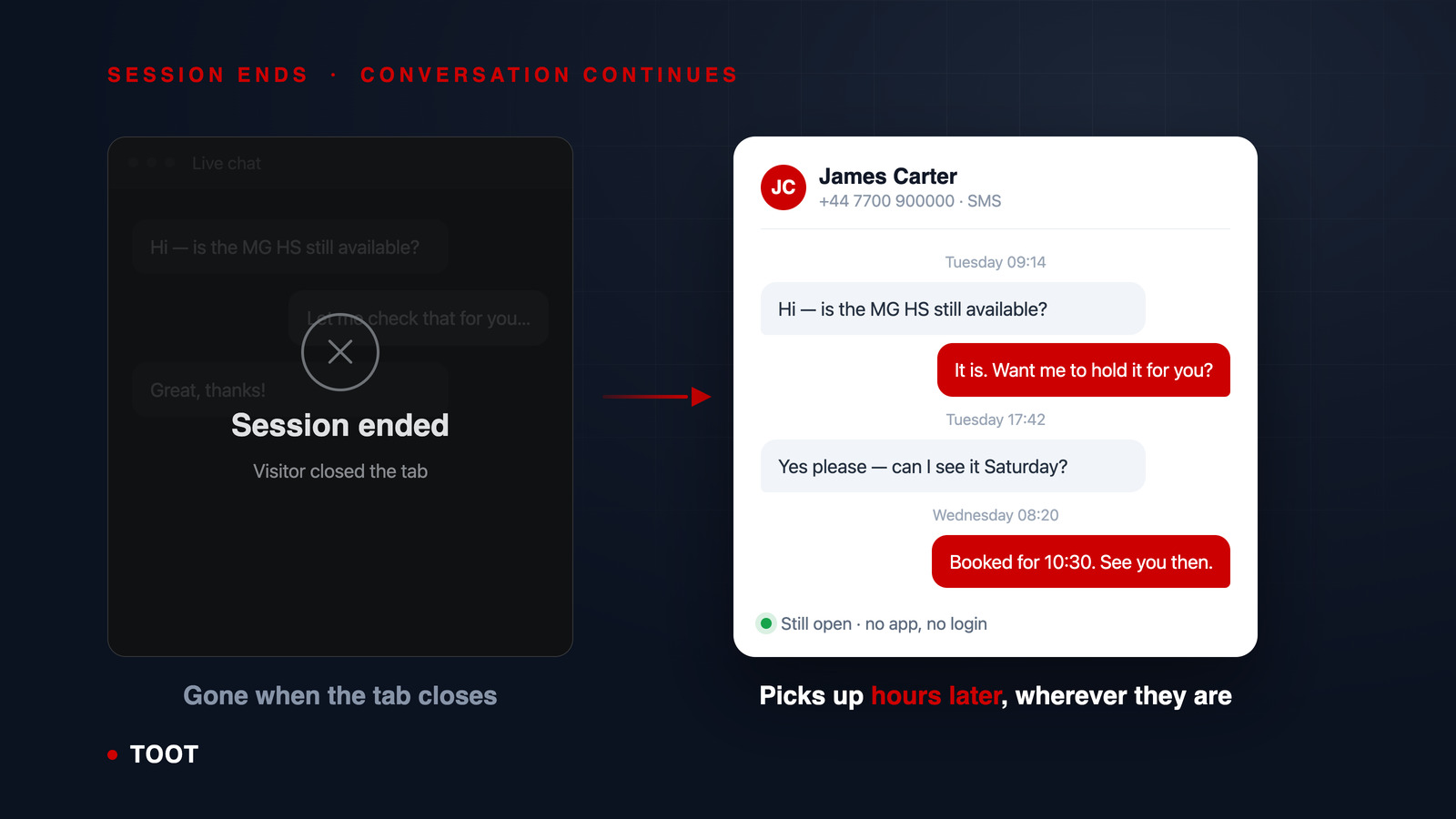
Live chat solved an important problem when websites needed a way to create an immediate digital conversation.
But customer behaviour has moved on.
The biggest weakness of traditional live chat is contained in the name itself: it expects the customer to be live.
If somebody starts a conversation and then gets interrupted, joins a meeting, drives home, puts their phone down or simply gets distracted by everyday life, that conversation can quickly lose momentum. Sessions expire, browser windows close and customers are often forced to start again.
SMS and RCS remove much of that friction.
A conversation can begin at 10am, pause at 10:15am and continue at 4pm — or even the following day.
The customer does not have to remain on your website.
They do not have to keep a browser window open.
They do not have to wait for an agent.
The conversation simply stays with them.
That matters because real customers do not behave like website sessions. Their lives continue around the conversation.
Someone enquiring about a car might have to collect their children. A customer considering a purchase might go into a meeting. Someone arranging an appointment may need to check their diary and reply later.
With SMS or RCS, none of that needs to terminate the customer journey.
From live session to persistent conversation
This is perhaps the fundamental difference.
Live chat creates a session.
SMS and RCS create a conversation.
And conversations are far more naturally aligned with how people communicate today.
RCS can take this even further by introducing rich content, imagery, buttons and suggested responses, allowing businesses to create much of the interactive experience associated with live chat without forcing the customer to remain on the website.
A conversation might begin with an enquiry and then continue over several hours or days:
Is this vehicle available?
Yes — would you like to see some images?
Yes please.
Customer returns three hours later.
Would Saturday morning work for a test drive?
The journey hasn’t been lost simply because the customer had something else to do.
The website should start the conversation, not imprison it
There will still be situations where live chat is useful, particularly where somebody wants immediate help while navigating a website.
But increasingly, businesses should be asking whether the conversation actually needs to remain there.
A better model may be:
Customer visits website → starts conversation → conversation moves naturally into SMS or RCS → customer continues when convenient.
That creates a much more persistent customer relationship.
For many businesses, the objective shouldn’t necessarily be to install another live-chat widget.
It should be to make sure that when a customer starts talking, the conversation doesn’t disappear when they close the browser.
The TOOT view
At TOOT, we believe customer communication should fit around people’s lives rather than expecting people to fit around a communication channel.
SMS and RCS allow conversations to remain open, persistent and accessible long after somebody has left the website.
That makes them particularly powerful across sales, service, appointments, enquiries, renewals and longer consideration journeys.
Live chat helped businesses bring conversation onto the website.
SMS and RCS allow businesses to take the conversation wherever the customer goes next.
And increasingly, that is where the customer experience needs to be.
Keep reading
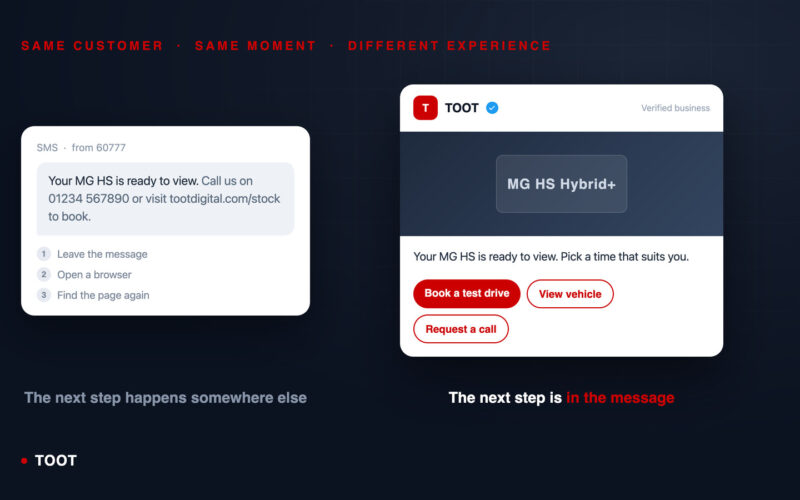
RCS vs SMS: Why the next generation of mobile messaging changes the customer experience
SMS delivers a message; RCS can deliver an experience. Eight things that change when your brand, rich media and tappable buttons live inside the conversation.
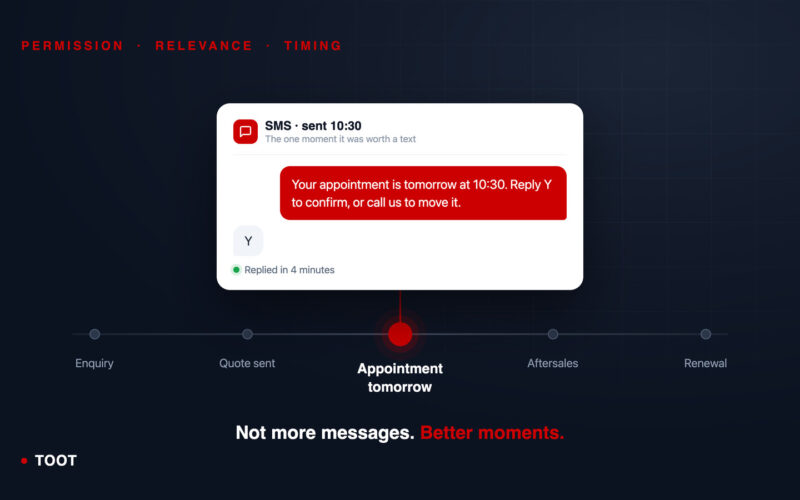
SMS works best when the moment matters
SMS earns attention when the timing is right. Eight practical ways to build opt-ins around permission, relevance and the moments where a text genuinely helps.