 Toot Digital
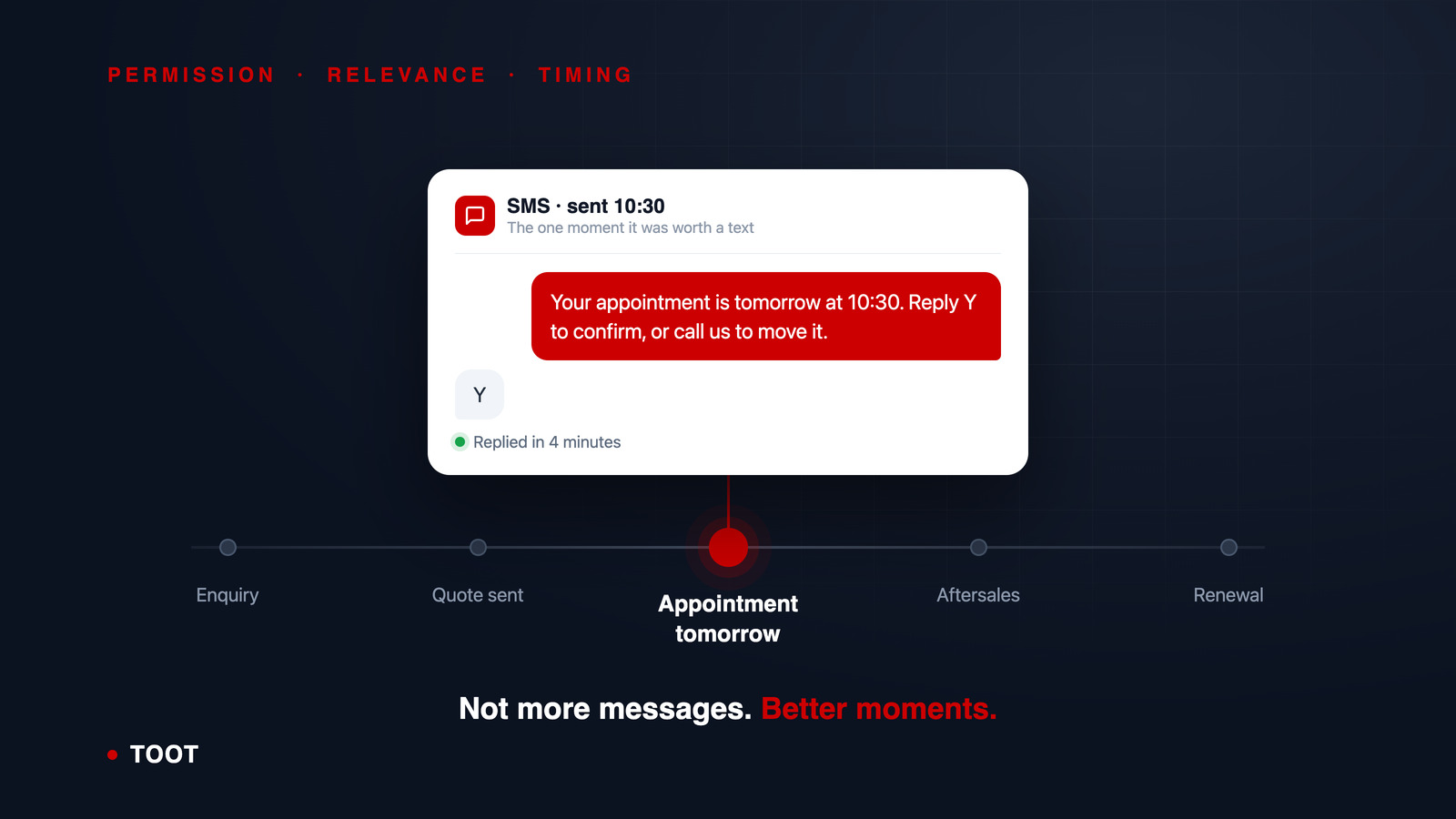
SMS earns its place in the customer journey because it is immediate.
When an appointment changes, a product becomes available, an event is about to start, a customer needs to take action or an opportunity has a limited window, a text message can cut through far more quickly than many other channels.
But an effective SMS strategy is not built by collecting the biggest possible database of mobile numbers.
It starts with something much more important: permission, relevance and timing.
The objective should be to understand where SMS genuinely improves the customer experience, give people a clear reason to opt in, and then use the channel intelligently alongside email, telephone, WhatsApp and other communications.
Here are eight practical ways businesses can make SMS a natural part of their customer journeys.
1. Start with the customer journey, not the mobile number
Most businesses already have numerous points where SMS could be introduced without creating an entirely new process.
Consider the interactions already happening across your customer journey:
- enquiries and quote requests
- appointments and bookings
- account registrations
- newsletter subscriptions
- event registrations
- product enquiries
- downloads and information requests
- purchases
- renewals
- aftersales and customer service interactions
Each creates an opportunity to ask whether the customer would find text updates useful.
The important question isn’t simply “Can we get their mobile number?”
It is:
“Would receiving an SMS at this point make the customer’s experience better?”
Someone booking an appointment may welcome a reminder. A prospect making an enquiry may appreciate an update when something changes. An existing customer may want to know when their renewal or next service date is approaching.
When SMS solves a genuine customer need, opting in feels like part of the service rather than another marketing request.
Naturally, businesses should also ensure their consent and communication preferences accurately reflect the channels the customer has agreed to use.
2. Sell the benefit of SMS, not the channel itself
Very few customers wake up thinking they would like to join another company’s “SMS database”.
They may, however, want:
- an alert when something becomes available
- a reminder before an appointment
- early information about a launch
- notification when bookings open
- a relevant offer
- an update about something they have enquired about
- a reminder when a renewal is approaching
- information that prevents them missing an important deadline
That distinction matters.
Instead of asking someone to “Subscribe to SMS”, explain what receiving those messages will actually do for them.
For example:
A motor retailer could offer customers updates when matching vehicles become available.
A recruitment company could notify candidates about suitable new roles.
A travel business could send an alert when new dates or availability are released.
An event organiser could offer reminders and important information on the day itself.
The value doesn’t always have to be a discount. In many customer journeys, convenience and good timing are valuable enough.
3. Use what you already know about your customers
For many organisations, the best potential SMS audience is already engaging through another channel.
An email subscriber cannot simply be treated as an SMS marketing subscriber, but existing customer relationships provide excellent opportunities to introduce the option.
SMS preferences can be promoted through:
- email campaigns
- customer portals
- preference centres
- automated communications
- account areas
- post-purchase journeys
- renewal communications
The opportunity becomes much stronger when it is personalised.
Rather than asking your entire database to sign up for generic text messages, use existing customer intelligence to make the proposition relevant.
Someone who frequently attends events might be offered event alerts.
A customer repeatedly researching a particular product might be offered availability notifications.
A customer approaching renewal could choose to receive a reminder.
A prospect currently moving through a sales journey could opt into useful progress updates.
Relevance creates a much stronger reason to opt in.
4. Ask at the point of intent
Timing matters just as much when asking someone to subscribe as it does when sending the SMS itself.
Immediately asking every website visitor for their mobile number may create very different results from approaching somebody who has already demonstrated genuine interest.
Useful behavioural signals could include someone:
- returning to the website
- visiting the same product several times
- viewing multiple related pages
- spending significant time researching
- reaching a pricing or enquiry page
- beginning an application
- looking at booking availability
- engaging with a particular campaign
This is where customer behaviour can help determine the next best action.
A visitor at the beginning of their research might simply need more information.
Another might benefit from an email journey.
Someone demonstrating considerably stronger intent may be ideally positioned to receive timely SMS updates.
The customer journey should determine the communication — not the other way around.
5. Give customers control over the conversation
Customers do not necessarily want every message through every channel.
Some will prefer email.
Some will respond better to SMS.
Others may want WhatsApp, telephone contact or a combination depending on the situation.
That is why communication preferences can be so valuable.
Email might remain the best choice for detailed information, educational content or longer communications.
SMS may be ideal for:
- reminders
- alerts
- short updates
- time-sensitive information
- simple calls to action
Telephone might become appropriate where a conversation is needed.
The more a business understands how and when a customer wants to communicate, the easier it becomes to create journeys that feel connected rather than intrusive.
6. Identify the lifecycle moments where SMS adds value
There are certain points in a customer lifecycle where SMS fits naturally.
Appointments and bookings
Confirm arrangements, provide reminders or communicate changes.
Enquiries and quotations
Keep prospects informed and create timely opportunities to re-engage.
Events
Provide registration confirmations, reminders and important information before or during the event.
Account registration
Allow customers to set communication preferences at the beginning of the relationship.
Purchase and delivery
Provide relevant updates throughout the process.
Post-purchase
Maintain the relationship through service, ownership and customer-care communications.
Renewal and retention
Use timely reminders to help customers take action before an important date passes.
The aim should never be to insert SMS everywhere.
It should be to identify the moments where speed, immediacy or convenience genuinely improve the experience.
7. Make SMS discoverable across every customer touchpoint
SMS opt-in doesn’t have to begin on your website.
Customers encounter brands across dozens of different environments, including:
- social media
- digital advertising
- physical locations
- events
- QR codes
- brochures
- point-of-sale material
- direct mail
- customer service interactions
Any of these can provide a route into an SMS journey.
Again, specificity matters.
“Join our SMS list” provides very little motivation.
Compare that with:
“Get an alert when new stock arrives.”
“Receive a reminder when bookings open.”
“Get appointment updates by text.”
“Be notified when matching vehicles become available.”
The second approach tells the customer precisely why sharing their mobile number could be useful.
8. Protect the value of the channel
Winning an SMS opt-in is only the beginning.
What happens afterwards determines whether the customer continues to see value in receiving messages.
A good starting point is a clear welcome message confirming what they have subscribed to and setting an expectation around what they will receive.
After that, restraint becomes important.
SMS should not simply become email squeezed into 160 characters.
Its strength is immediacy.
Use it when the moment justifies it:
- an appointment is approaching
- availability has changed
- an important deadline is close
- a customer has reached a key stage
- something they expressed interest in becomes available
- their recent behaviour suggests that now is the right time to engage
If a communication can comfortably remain unread for four days without affecting anything, there is a good chance SMS wasn’t the best channel for it.
Quality beats quantity
A database containing hundreds of thousands of mobile numbers isn’t necessarily a valuable SMS audience.
A much more useful audience consists of customers where you understand:
who they are,
what they are interested in,
what they have consented to receive,
how they prefer to communicate,
where they are in their journey,
and when there is a genuine reason to contact them.
Connect those elements and SMS stops being a bulk messaging tool.
It becomes part of a much more intelligent customer engagement strategy.
Bringing SMS into the connected customer journey with TOOT
TOOT is designed to help organisations move beyond isolated campaigns and build communication around the customer journey.
SMS can work alongside email, WhatsApp, RCS and other engagement channels, with customer data, triggers, preferences and activity helping determine what should happen next and which channel should be used.
That might mean:
- automatically reminding a customer about an appointment
- re-engaging a prospect after an enquiry
- triggering an SMS following a particular customer action
- nurturing customers across multiple channels
- supporting renewal and retention journeys
- sending personalised alerts based on customer data
- continuing conversations rather than simply broadcasting messages
The opportunity isn’t simply to send more texts.
It is to make every message more relevant, more timely and more connected to what the customer is actually doing.
That is where SMS becomes significantly more powerful — not as a standalone channel, but as part of the wider conversation between a business and its customers.
Keep reading
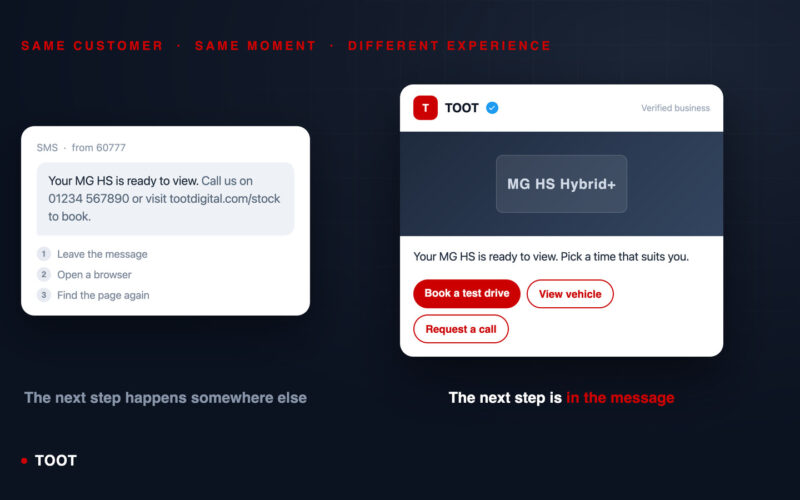
RCS vs SMS: Why the next generation of mobile messaging changes the customer experience
SMS delivers a message; RCS can deliver an experience. Eight things that change when your brand, rich media and tappable buttons live inside the conversation.
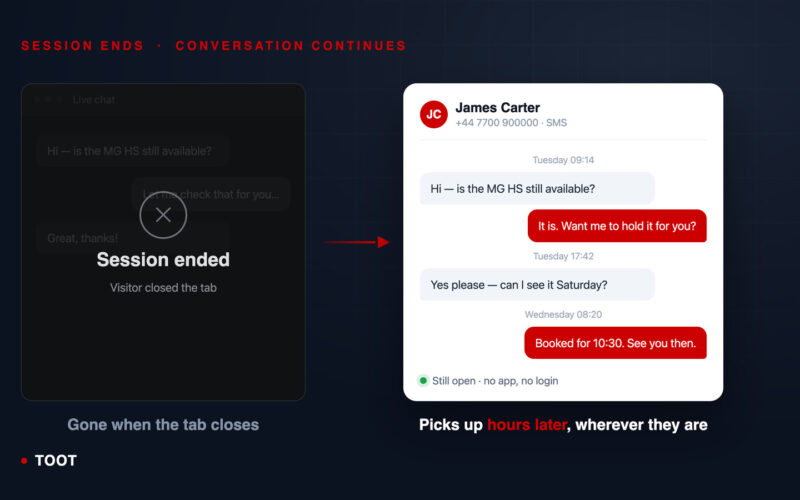
Is live chat becoming outdated?
Live chat expects the customer to be live. SMS and RCS let a conversation pause and pick up hours later — without the customer staying on your website.