RCS vs SMS: Why the next generation of mobile messaging changes the customer experience
 Toot Digital
9 min read
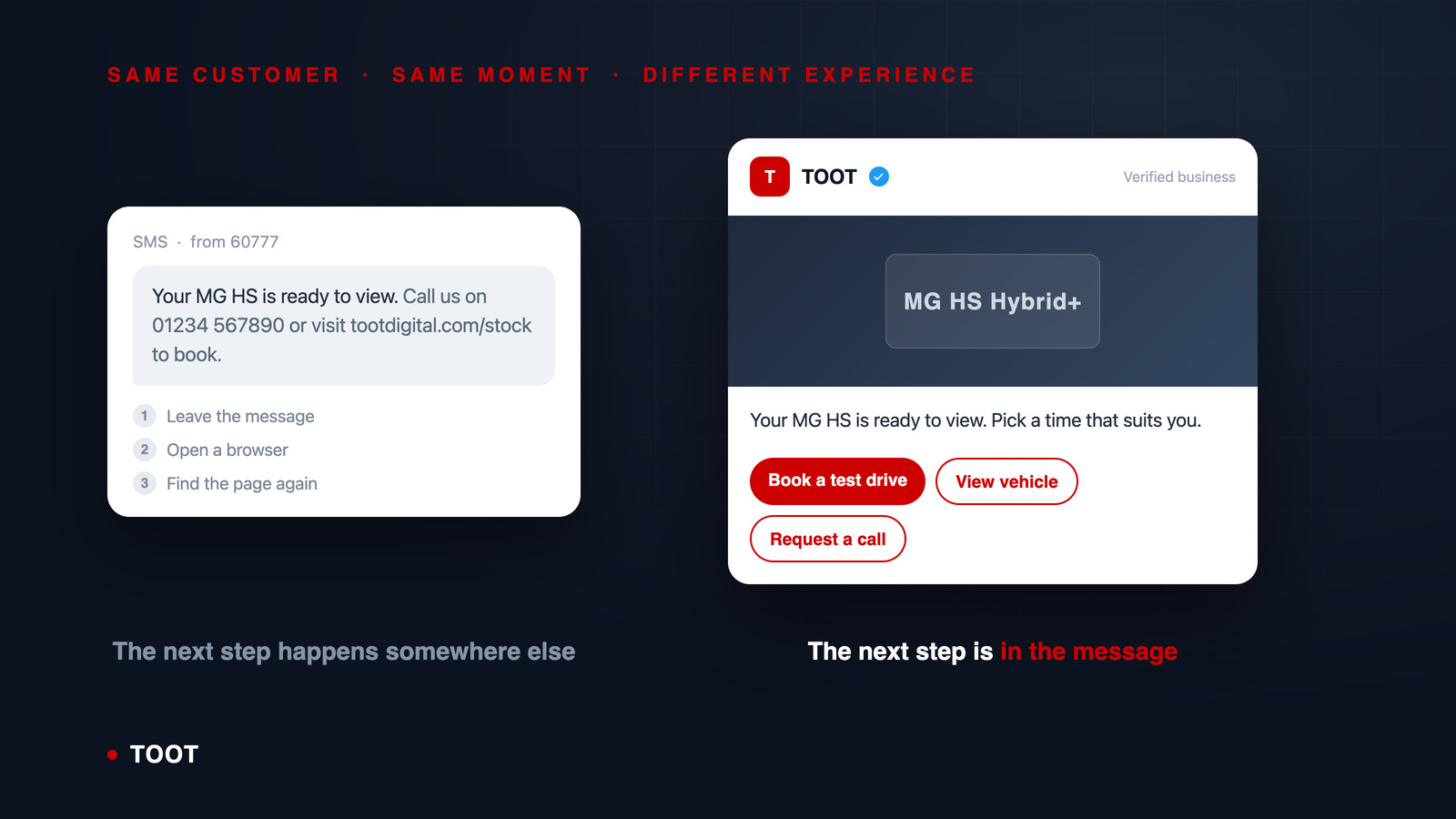
For decades, SMS has been one of the most dependable ways for businesses to reach customers.
It is immediate, familiar, widely available and remarkably effective when a message simply needs to be seen.
RCS — Rich Communication Services — takes that same fundamental advantage of communicating through the customer’s native messaging environment and adds something SMS was never designed to provide:
a richer, branded and genuinely interactive customer experience.
Instead of receiving a few lines of text and a link, customers can potentially interact with imagery, video, buttons, suggested responses, rich cards, carousels and conversational journeys directly within their messaging application. RCS can also support delivery and read receipts and other richer messaging functionality depending on the device and implementation.
For businesses, that changes mobile messaging from something you send into an experience customers can actually engage with.
SMS is excellent at delivering a message. RCS can create an experience.
Consider a traditional promotional SMS:
Your new vehicle is available to view. Click here to see the details: [link]
Simple. Fast. Effective.
Now consider what the same interaction could become through RCS.
The customer could receive:
- an image of the vehicle
- model and specification information
- pricing or availability
- a button to book an appointment
- a button to request a call
- suggested responses
- directions to the dealership
- potentially a carousel showing several relevant vehicles
And the customer can interact directly from the conversation.
Google’s RCS for Business specification supports rich cards containing media, text and suggested actions, as well as carousels containing multiple cards. Suggested actions can also trigger useful activities such as opening a URL, making a telephone call or viewing a location.
That significantly reduces the gap between receiving a message and taking action.
1. Your brand can become part of the conversation
One of the limitations of conventional business SMS is presentation.
However good the message might be, the experience is predominantly text based.
RCS gives organisations far greater opportunity to create a recognisable branded messaging environment.
For customers, that matters.
The more confident somebody is about who they are communicating with, the easier it becomes to engage with the conversation.
This is particularly valuable for organisations where trust is important — financial services, automotive, healthcare, travel, utilities, retail and professional services being obvious examples.
Mobile messaging no longer needs to feel like an anonymous notification.
It can feel like an extension of the brand itself.
2. Rich media can explain far more than text alone
Sometimes a few lines of text are exactly what is required.
At other times, businesses are attempting to squeeze a visual proposition into a fundamentally non-visual channel.
RCS changes that.
Rich cards can incorporate images, GIFs and video alongside explanatory copy and customer actions.
Imagine the difference across some typical customer journeys.
Automotive
Instead of:
We’ve found a vehicle matching your enquiry. Click here.
The customer could see the actual vehicle, key information and actions such as:
Book a test drive
Request a call
View vehicle
Property
Show the property, headline information and offer:
Arrange viewing
See details
Talk to us
Travel
Show destinations, dates and offers rather than sending customers to a generic landing page.
Retail
Present several products through a carousel and allow the customer to explore relevant options immediately.
The communication becomes considerably more visual and engaging without requiring customers to first leave their messaging environment.
3. Buttons remove friction
One of the most valuable developments in RCS isn’t necessarily the imagery.
It is the ability to make the next action obvious.
Traditional SMS often asks customers to interpret what they should do next:
“Call us on…”
“Visit…”
“Reply YES…”
“Click the following link…”
RCS can present clear suggested actions and responses.
For example:
Book now
Yes, I’m interested
Call me
Find nearest location
View availability
Remind me later
RCS for Business supports suggested replies as well as actions including opening URLs, calling telephone numbers and interacting with locations.
Removing even a small amount of friction from a customer journey can matter.
If somebody can move forward with one tap rather than opening a website, finding the relevant page and completing several additional steps, businesses have a much better opportunity to maintain the customer’s attention.
4. RCS creates conversations rather than broadcasts
The biggest opportunity may be the shift from outbound messaging towards genuine two-way engagement.
Businesses have traditionally used SMS very effectively for alerts, reminders and promotional messages.
But modern customer journeys increasingly need a response.
A customer might want to say:
I’m interested.
Not right now.
Can somebody call me?
Show me something else.
I need help.
Change my appointment.
RCS allows businesses to design conversational pathways around these interactions.
Customers can use suggested responses or enter their own message, while the organisation can use automation, AI or human intervention to determine what should happen next. Google’s RCS Business Messaging framework explicitly supports incoming free-text responses, suggested replies, locations and other customer interactions.
That makes messaging much more valuable as part of a connected sales or customer-service journey.
5. Customer journeys can remain inside the message for longer
Every additional step placed between the customer and the desired action creates an opportunity for them to disappear.
An SMS might send somebody to a web page.
The web page might ask them to navigate elsewhere.
They might then need to complete a form.
At each stage, potential engagement can reduce.
RCS provides an opportunity to bring more of that journey into the conversation itself.
The customer can be shown relevant choices and guided towards an action without immediately being forced elsewhere.
A retail customer can explore products.
A dealership customer can choose a vehicle.
An event customer can respond to an invitation.
A service customer can select what they need.
A prospect can request a conversation.
RCS starts to make the messaging environment itself part of the digital customer journey.
6. Measurement becomes richer too
SMS measurement has traditionally concentrated heavily on delivery and subsequent actions such as link clicks.
RCS introduces the potential for greater insight into what happens within the messaging interaction itself.
Depending upon the implementation, businesses can work with delivery information, read receipts and customer interactions with suggested responses and actions.
That can help answer much more useful questions.
Did the customer receive the communication?
Did they engage?
Which option did they select?
Which message or proposition generated the response?
What happened next?
For organisations building automated customer journeys, these signals can become triggers for the next stage of communication.
And that is where things become particularly interesting.
7. RCS works beautifully with automation
The real opportunity doesn’t come from creating a beautiful message and sending it to everybody.
It comes from combining RCS with customer intelligence.
Imagine a customer researching a new vehicle.
Their behaviour indicates interest in one particular model.
Rather than sending a generic campaign, a journey could automatically trigger an RCS communication showing that vehicle or related stock.
The customer selects:
I’d like a test drive.
That response could trigger:
- an automated booking journey
- a call from the sales team
- another relevant RCS interaction
- an SMS confirmation
- an email containing more detailed information
- an update within the CRM
This is where messaging becomes orchestration.
The important thing isn’t RCS itself.
It is what RCS allows the wider customer journey to do.
8. RCS doesn’t mean SMS suddenly becomes obsolete
This is important.
RCS should not simply be viewed as the replacement for SMS.
SMS still has enormous strengths:
Reach.
Simplicity.
Speed.
Familiarity.
And SMS remains extremely useful when a short, immediate communication is exactly what the customer needs.
RCS availability and supported functionality can also vary according to devices, networks, messaging clients and individual capabilities, which is why RCS implementations should consider capability checking and appropriate fallback journeys. Google itself recommends checking the capabilities supported by the recipient’s device when designing RCS experiences.
The intelligent strategy therefore isn’t:
SMS or RCS?
It is:
Which channel gives this customer the best experience at this particular moment?
Sometimes that will be RCS.
Sometimes it will be SMS.
Sometimes email, WhatsApp or a telephone conversation will be more appropriate.
A modern communications platform should be capable of making those channels work together.
From messaging channel to digital storefront
This is perhaps where RCS becomes most exciting.
A customer’s messaging inbox is traditionally somewhere businesses send notifications.
RCS starts turning that same environment into somewhere customers can discover, explore, respond and act.
That creates possibilities far beyond conventional campaigns.
An automotive retailer could effectively create a miniature vehicle showroom inside a customer conversation.
A retailer could display relevant products.
A travel company could present destinations.
A recruitment company could show vacancies.
A property company could present available homes.
A service organisation could give customers a visual menu of the help available to them.
The messaging conversation begins to become a digital storefront.
And importantly, it is a storefront delivered into an environment customers already use every day.
RCS and SMS together: the TOOT approach
At TOOT, we don’t believe the future is about replacing one communication channel with another.
It is about making channels work intelligently together.
SMS remains an incredibly powerful tool when immediacy and universal simplicity matter.
RCS adds a new layer of possibility when the customer journey benefits from branding, rich content, interaction and conversation.
Combine those capabilities with customer data, behavioural triggers, automation and two-way messaging and businesses can move beyond the traditional model of:
Create campaign → Send message → Hope somebody clicks.
Instead, communication can react to the individual customer:
Understand the customer → identify the moment → choose the channel → start the conversation → respond to their behaviour → trigger the next best action.
That is a fundamentally different approach to mobile messaging.
And as RCS continues to mature across the mobile ecosystem, the opportunity is becoming increasingly significant. The GSMA published RCS Universal Profile 4.1 in July 2026, continuing the development of the standard across networks and devices, while Apple now supports RCS messaging on iPhone and is progressively rolling out additional capabilities with supporting operators.
SMS made mobile messaging one of the world’s most powerful communication channels.
RCS gives businesses the opportunity to turn that channel into an experience.
Keep reading
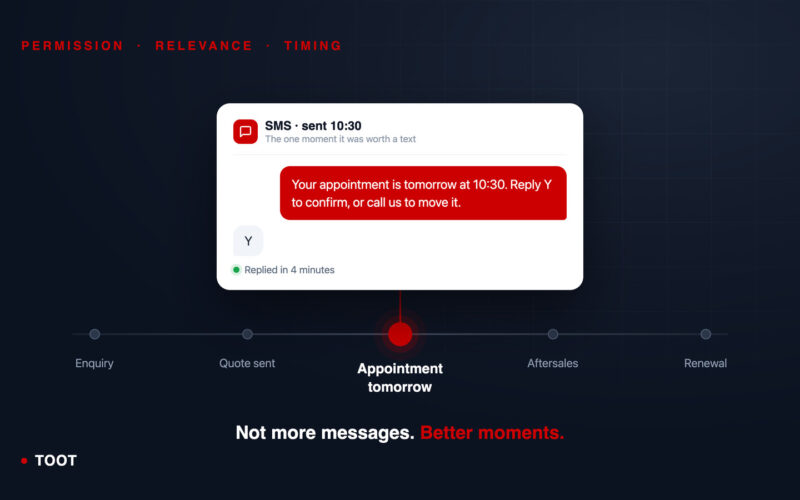
SMS works best when the moment matters
SMS earns attention when the timing is right. Eight practical ways to build opt-ins around permission, relevance and the moments where a text genuinely helps.
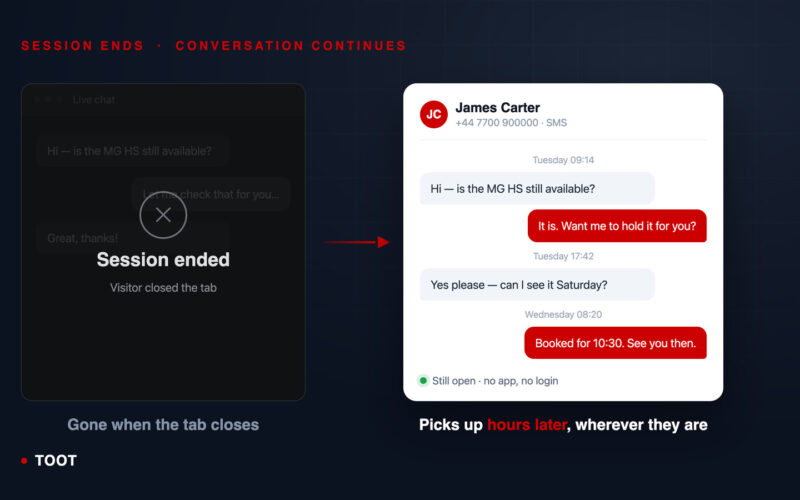
Is live chat becoming outdated?
Live chat expects the customer to be live. SMS and RCS let a conversation pause and pick up hours later — without the customer staying on your website.